GoldenBrain
This entry is unpaid and independent. When we do point to a specific product, we link to authorized retailers and may earn a commission at no extra cost to you.
Which GoldenBrain this review covers
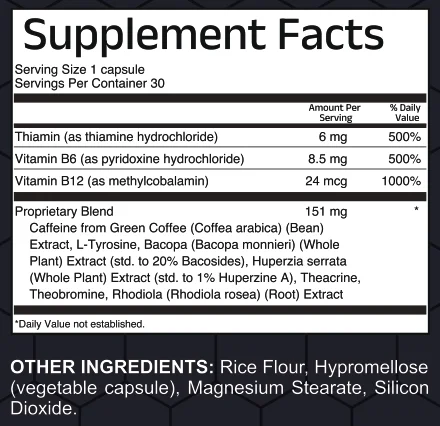
A search for the name returns a page of near-identical "official" domains, mostly affiliate pages. The one acting as the seller is goldenbrain.us: its order buttons go straight to a BuyGoods checkout under a single vendor account, its footer reads "GoldenBrain Research," and after payment the buyer lands on getgoldenbrain.com, which loads the full bottle-label artwork reproduced on this page. That label and that seller's own pages are what we graded.
The label, line by line
One capsule, 30 per bottle. Three vitamins carry amounts: thiamin 6 mg, B6 8.5 mg and B12 24 mcg, five to ten times the Daily Value. The rest share an undivided 151 mg proprietary blend, in this order: green coffee bean extract as a caffeine source, L-tyrosine, whole-plant bacopa (20% bacosides), Huperzia serrata (1% huperzine A), theacrine, theobromine and rhodiola root extract. The distributor is listed as "Golden Brain" at a PO box in Ogden, Utah — an address that also turns up on the labels of unrelated direct-to-consumer supplements.
Printing the blend total at least sets a ceiling: if all 151 mg were bacopa, which it is not, the capsule would still hold about half the lowest daily amount used in the bacopa trials below.
Five places the label and the sales page disagree
- StimulantsFAQ: "no caffeine and no stimulants." Label: caffeine from green coffee bean, theacrine and theobromine, in amounts nobody states.
- Daily doseFAQ: two capsules each morning. Label: one capsule a day. Followed as the sales page says, a "30-day supply" lasts 15 days.
- IngredientsHero copy: royal jelly with "nootropic botanicals." Badges on the same page: baobab fiber, L-arabinose, spermidine and konjac glucomannan. The page's structured product data: bacopa, ginkgo, lion's mane, royal jelly, phosphatidylserine and B12. Only bacopa and B12 survive onto the label.
- FormTestimonials in the page's built-in HTML praise "one scoop" of a powder, and one names a different product. The label describes vegetable capsules.
- RefundsFAQ: a full refund "even if the bottles are empty." Return policy: sealed bottles only, no request before 30 days of use, 15% restocking fee, shipping and return postage on the buyer, and fulfilled orders "cannot be canceled or refunded under any circumstances" unless refused on arrival.
The GoldenBrain blend — B1, B6, B12, green-coffee caffeine, L-tyrosine, theacrine, theobromine, bacopa, rhodiola and Huperzia serrata — is the same ingredient list we recorded on one of the nine NeuroMind storefronts in RPT-29 a day earlier. Two brand names, one stock formula: judge the label, not the story around it.
What the research says about this blend
Bacopa has the deepest file. Pooling nine randomized trials that each ran 12 weeks or longer, a 2014 meta-analysis covering 518 people saw modest gains in attention speed and choice reaction time, and its authors said a large, well-designed trial was still needed. A 2012 systematic review of six 12-week trials found improvement on 9 of 17 free-recall memory tests and little elsewhere. Daily doses in that review ran 300 to 450 mg of extract, two to three times GoldenBrain's whole blend.
Huperzine A slows the breakdown of acetylcholine, the same mechanism as a class of prescription drugs, so it can interact with medication. In a 210-person U.S. trial in adults with a memory-related diagnosis, 200 micrograms twice a day did not beat placebo on the main cognitive test; a higher dose showed a signal at 11 weeks that had faded to non-significance by week 16. Amounts here are measured in micrograms, and the GoldenBrain label gives none.
L-tyrosine: a 2015 review found possible help during short, stressful or demanding tasks, not as a daily booster. Rhodiola's systematic review found eleven small trials, four on mental performance, with "a lack of independent replications." Theacrine's main human study is an eight-week safety trial in 60 young adults taking 200 or 300 mg a day; it measured safety markers and mood ratings, not memory.
No trial of GoldenBrain as a finished product appears in PubMed. A sales-page checklist calls it trial-tested and completely safe; we found no support for either.
Red flags beyond the label
Leftover parts. The storefront's checkout script is written to rewrite links on a payment domain named after VapoFil, an unrelated product. A code comment labels the product data as a schema for a blood-sugar product. The "Scientific References" block lists papers on vitamin D, vitamin A and vitamin K, plus an HIV pilot trial and a parathyroid study — none on any GoldenBrain ingredient. On October 8 every product image on goldenbrain.us returned "not found."
Contact details that don't match. The label and the website's contact pages list two different Los Angeles-area phone numbers, and the guarantee section on the sales page sends refund requests to a third-party support address on a different domain from the one printed on the bottle.
The post-purchase ladder. After checkout, a page warns "Your order is not complete yet," runs a three-minute timer and offers 12 more bottles at $33 each ($396) or six at $19 ($114). Decline, and a "pick a door" game offers 12 bottles for $228. In the seller's own wording, the upgrade button reads "Upgrade my treatment" next to a promise of "24/7 Medical Support from the GoldenBrain team." A dietary supplement is not a treatment, and no page names a clinician.
Lookalikes that switch products. Eight other "Golden Brain" domains describe at least four different formulas between them, from a lion's mane and bacopa pairing to a longer mix built around royal jelly, ginseng and rhodiola. Two go further: on goldenbrain-co.com the buy buttons lead through ClickBank to a product called Phytomem One, and on us-goldenbrain.com they open an order page for MemoClear. A shopper can pay for "GoldenBrain" and receive neither the formula described nor the product named.
The ads. We did not capture the ads that feed these pages, so we won't describe them. Memory supplements sold through this kind of funnel are often promoted with news-style pages and doctored video of famous faces; the FTC's consumer alert explains how to spot a fake celebrity pitch.
Price, as listed October 8, 2026
On goldenbrain.us: one bottle $89 plus shipping, three for $207 ($69 each) and six for $294 ($49 each) with free U.S. shipping. The getgoldenbrain.com order page has no single bottle; its smallest package is two bottles at $158, with $19.99 added for shipping. Charges are described as one-time; we placed no order and cannot confirm billing.
Why Grade C
We reserve Grade C for a formula built from genuine, researchable ingredients that is sold in a way that defeats the reason to buy it. The label is more honest than the sales page, and contradicts it on caffeine, dose, ingredients and refunds: a buyer following the sales copy would take double the labeled dose of a caffeine-containing product believing it has none. That weighs more in this verdict than the thin evidence at 151 mg.
This capsule contains caffeine, theacrine and theobromine in undisclosed amounts, despite sales copy saying otherwise. Count it toward your daily caffeine — the FDA's general guide for healthy adults is about 400 mg a day — and take care if you are caffeine-sensitive or stack it with coffee. Huperzine A can interact with prescription drugs that act on acetylcholine. If you are pregnant or nursing, under 18, on any prescription or living with a medical condition, clear it with your doctor or pharmacist first.
If the ad caught you because you want to support memory and focus as part of a daily routine, bacopa is the ingredient in this blend with the most consistent human data and it is sold alone at a stated amount. Doctor's Best Bacopa, 320 mg, 60 veggie caps gives one ingredient per capsule: 320 mg of whole-plant bacopa extract standardized to 55% bacosides (the branded Synapsa extract), one capsule a day, with no caffeine. That falls inside the 300–450 mg range used in the trials above. Two caveats: in the trials, bacopa's effects took about 12 weeks to show, and Amazon lists this bottle as one it will not take back once delivered.
Listing as checked October 8, 2026: $19.99, available, Amazon fulfillment with Doctors Best as the seller, 4.4 stars from about 600 reviews.
Check current listing on Amazon → https://www.amazon.com/dp/B01MYOLVD7- Vendor pages opened directly on October 8, 2026 (cited, not linked): goldenbrain.us (home page, its config.json product file, and its terms, contact, return-policy and shipping pages); getgoldenbrain.com order page and post-purchase offer pages; the full bottle-label artwork those pages load from an image host. All product images on goldenbrain.us returned HTTP 404 the same day.
- Lookalike domains opened October 8, 2026 (cited, not linked): goldenbrain-co.com (buy links to a ClickBank offer for Phytomem One); us-goldenbrain.com (buy links to a MemoClear order page); gooldenbrain.com; golldenbrain.com; goldenbrrain.com; goldenbbrain.com; goldenbraiin.com; goldensbrain.com.
- The Cognitive Report, RPT-29: NeuroMind, October 7, 2026. neuromind.thecognitivereport.com
- Kongkeaw C, et al. Meta-analysis of randomized controlled trials on cognitive effects of Bacopa monnieri extract. J Ethnopharmacol. 2014;151(1):528-35. PubMed 24252493
- Pase MP, et al. The cognitive-enhancing effects of Bacopa monnieri: a systematic review of randomized, controlled human clinical trials. J Altern Complement Med. 2012. PubMed 22747190
- Rafii MS, et al. A phase II trial of huperzine A … Neurology. 2011;76(16):1389-94 — 210 participants, 16 weeks. PubMed 21502597
- Jongkees BJ, et al. Effect of tyrosine supplementation on clinical and healthy populations under stress or cognitive demands — a review. J Psychiatr Res. 2015;70:50-7. PubMed 26424423
- Hung SK, Perry R, Ernst E. The effectiveness and efficacy of Rhodiola rosea L.: a systematic review of randomized clinical trials. Phytomedicine. 2011;18(4):235-44. PubMed 21036578
- Taylor L, et al. Safety of TeaCrine, a non-habituating, naturally-occurring purine alkaloid over eight weeks of continuous use. J Int Soc Sports Nutr. 2016;13:2. PubMed 26766930
- U.S. Food and Drug Administration. Questions and Answers on Dietary Supplements. fda.gov
- U.S. Food and Drug Administration. Spilling the Beans: How Much Caffeine is Too Much? fda.gov
- Federal Trade Commission. Did a celebrity really endorse THAT? Maybe not. Consumer alert, April 2024. consumer.ftc.gov
- Amazon.com listing B01MYOLVD7, Doctor's Best Bacopa, 320 mg, 60 Veggie Caps — price, stock, seller, return status and label text as displayed October 8, 2026.
These statements have not been evaluated by the FDA. This product is not intended to diagnose, treat, cure, or prevent any disease. Talk to a healthcare provider before starting any new supplement.